Buying guide
Phone body size vs screen diagonal: what to compare
Compare width, height, depth and mass at the same scale instead of treating display inches as hand size.
Published
Research and writing prepared with AI assistance.
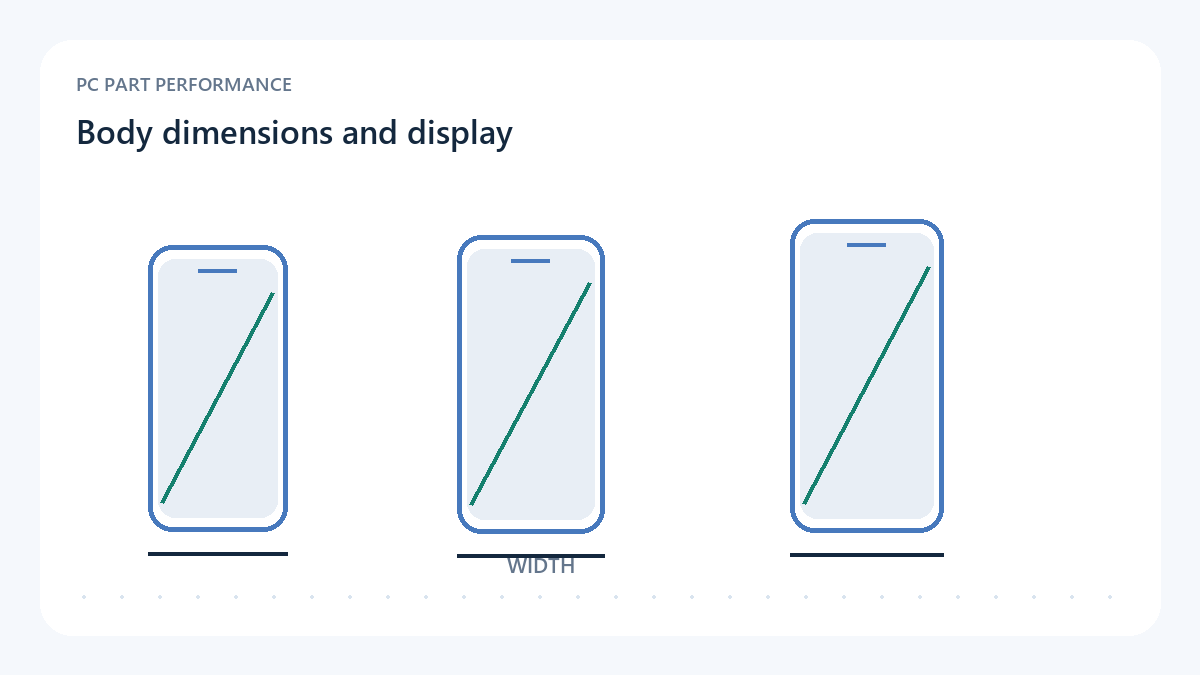
The screen and the object answer different questions
A display diagonal describes a screen measurement. Body width, height and depth describe the object you hold and put in a pocket. Neither tells the whole story alone. A phone can offer a larger display without becoming proportionally wider, while a protective case can make the assembled object larger than the published bare-body measurements. Begin by deciding which question you want to answer: viewing area, reach, grip or carrying space.
Use millimetres for the body and keep each axis labelled. A manufacturer's specification may list dimensions in a different order from another brand. Copying three numbers without identifying width and height can reverse the comparison. Record the exact model, including Pro, Plus or other suffixes. The following examples are an illustrative verified cohort, not a claim to cover the newest or smallest phones available in October 2026.
Use body measurements with exact model labels
Apple's iPhone 16 and iPhone 16 Pro demonstrate why display size is an incomplete shortcut. The Pro is fractionally narrower, but taller, deeper and heavier in the published specifications. That combination cannot be reduced to a simple statement that one is easier for every hand. The table keeps the dimensions visible instead of turning them into a comfort score.
For the Pixel 9, the inspected Google Help table supplies the older model's body data. A former Google Store Pixel 9 URL now redirects to newer product content, so a familiar-looking link was insufficient. The Samsung example uses the base Galaxy S25 from its original global specification table. Regional cellular and SIM details need separate evidence; a body comparison does not settle them.
| Exact model | Height × width × depth, mm | Mass |
|---|---|---|
| iPhone 16 | 147.6 × 71.6 × 7.8 | 170 g |
| iPhone 16 Pro | 149.6 × 71.5 × 8.25 | 199 g |
| Pixel 9 (ROW table) | 152.8 × 72 × 8.5 | 198 g |
| Galaxy S25 (base) | 146.9 × 70.5 × 7.2 | 162 g |
Sources: Apple Support — iPhone 16 technical specifications · Apple Support — iPhone 16 Pro technical specifications · Google Pixel Help — Pixel phone hardware technical specifications · Samsung Mobile Press — Samsung Galaxy S25 Series sets the standard of AI phone as a true AI companion
Read a same-scale outline carefully
A same-scale comparison places outlines against the same numeric reference. It is useful for seeing relative width and height without the camera perspective of two product photographs. Check whether the tool preserves that relationship when the display is narrow or zoomed. A comparison can remain proportionally correct while becoming smaller than the physical devices on your monitor. Same scale between drawings is not automatically life size.
If you want a life-size reference, follow the tool's calibration instructions and confirm the reference against a ruler or another known object. Browser zoom, screen density and operating-system scaling can affect the apparent size. If calibration is unavailable, use the outlines for relative differences and the millimetre values for a physical template. Do not claim that a screenshot will reproduce the object exactly on another person's screen.
Add the things an outline cannot measure
A two-dimensional body outline does not reproduce the weight, edge shape, camera projection, friction or the case you intend to use. Width can help narrow a shortlist, but it is not a measured result for thumb reach. Your grip and the tasks you perform matter. Think separately about typing, reaching the top of a screen, holding the camera and carrying the device. A short in-person trial can answer questions that geometry cannot.
Make a simple paper rectangle from the published height and width when a trial is unavailable. Label it with the model and keep it distinct from a depth or weight simulation. Compare it to your current phone and the space where you carry it. Then request the dimensions of the intended protective case. A bare-phone difference that looks small on screen may be less relevant than the case or accessory combination you actually choose.
Use size as one part of a buying decision
After the physical shortlist, check regional model identity, software support, accessibility needs and the functions you rely on. A comfortable size does not establish battery endurance, camera quality or cellular compatibility. Those require their own specification or test evidence. Conversely, a broad product ranking may not reflect the grip or pocket requirement that led you to compare body dimensions.
The phone size tool can make the geometry easier to inspect, provided that you keep its source and scale limits in view. Save the exact model and measurements beside your notes rather than just saying that two phones have similar screen inches. The result should be a more focused trial or shortlist, not a promise that an unhandled phone will feel perfect.
- Exact model suffix and dimension order checked
- Bare body distinguished from protective case
- Relative scale distinguished from calibrated life size
- Depth, mass and grip questions kept separate
- Regional features and support checked after the size shortlist
Use the tools with this evidence
Inspected sources and limits
- Apple Support — iPhone 16 technical specifications
Inspected 2026-10-11. iPhone 16 body: height 147.6 mm, width 71.6 mm, depth 7.8 mm, mass 170 g. Used for an explicitly illustrative size cohort.
Body dimensions, not case size, reachable screen area or hands-on ergonomics. Canadian support URL does not establish the regional SIM or cellular configuration of a seller's exact unit.
- Apple Support — iPhone 16 Pro technical specifications
Inspected 2026-10-11. iPhone 16 Pro body: height 149.6 mm, width 71.5 mm, depth 8.25 mm, mass 199 g.
Not Pro Max. Size and mass may vary with configuration or manufacturing; neither a measured grip study nor a current buying recommendation.
- Google Pixel Help — Pixel phone hardware technical specifications
Inspected 2026-10-11. Pixel 9 ROW body: height 152.8 mm, width 72 mm, depth 8.5 mm, mass 198 g. The long multi-generation table was inspected at the Pixel 9 section, not the current Pixel 11 section.
Former Google Store UK Pixel 9 URL redirects to newer product content; it was rejected as evidence for Pixel 9. Regional radios/SIM, case bulk and support terminal dates require separate checks.
- Samsung Mobile Press — Samsung Galaxy S25 Series sets the standard of AI phone as a true AI companion
Inspected 2026-10-11. Global launch specification table: base Galaxy S25 width 70.5 mm, height 146.9 mm, depth 7.2 mm, mass 162 g. Announcement describes seven OS generations and seven years of security updates from global launch.
Not S25+ or Ultra; no current-stock claim, regional carrier compatibility, hands-on battery result or exact final patch date inferred.