AI demand can influence the wider semiconductor market, but it does not explain every gaming GPU price. Data-center accelerators and retail graphics cards differ, and a price claim needs evidence for the specific model, market and time period.
| Check | Why it matters |
|---|---|
| Exact card and memory capacity | Different board variants can have different prices. |
| Country, retailer and date | Prices, taxes, sales and stock vary by market. |
| New, used or marketplace stock | Seller type and condition change the comparison. |
| Evidence linking costs to AI | A large AI order alone cannot quantify a retail price effect. |
Gaming cards and data-center accelerators are different products
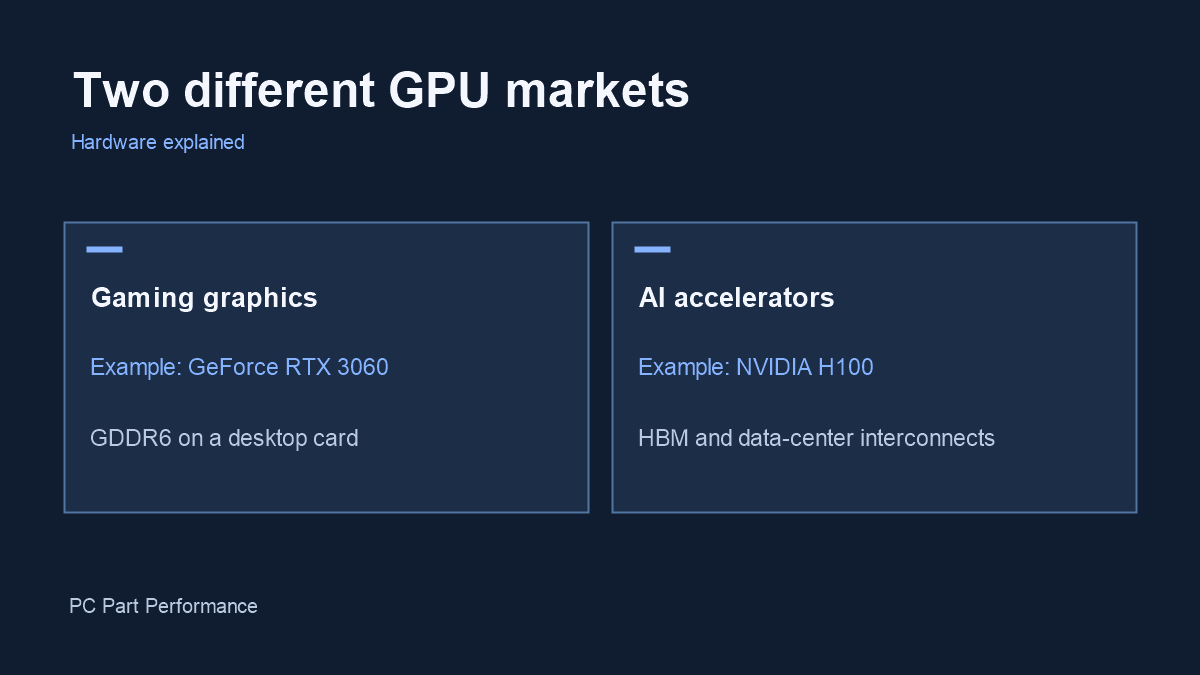
NVIDIA’s H100 documentation describes a data-center accelerator with HBM and interconnect features for large computing systems. An RTX 3060 retail board uses GDDR6 and a cooler designed for a desktop PC. They belong to different product lines and are not interchangeable purchases.
That distinction matters when a headline says that companies are buying GPUs. It may refer to complete servers, specialized accelerator modules, workstation cards or consumer graphics cards. Without that detail, it is difficult to connect the report to the product on a gamer’s shopping list.
Where the connection can exist
Memory suppliers describe AI as an important source of demand and investment. That establishes a real relationship between AI infrastructure and the memory industry. It does not quantify how much of the price of an individual gaming card is caused by AI.
Our interpretation is that shared suppliers and manufacturing investment create potential indirect links. To establish a particular price effect, we would need evidence about capacity allocation, component costs, shipments and retail pricing over the same period. An announcement about a large AI project alone cannot supply those measurements.
Separate a price observation from an explanation
A useful observation identifies the exact card, seller, region, currency and date. For example, a comparison of two offers for the same MSI model is more informative than comparing an unspecified RTX 3060 with a premium overclocked version from another brand.
After establishing the change, investigate possible explanations. Local stock, a discontinued model, seller markups, sales ending, taxes and exchange rates are questions to check. These are alternative explanations to investigate, not a claim that each one caused a change in your market.
How to compare a gaming GPU fairly
Choose the games, resolution and graphics settings you care about. Then compare independently measured performance, memory capacity, board dimensions, power requirements and support. A higher price does not make a card a better upgrade for your PC.
Keep the total cost visible. A card that requires a different case or power supply may cost more than its shelf price suggests. Confirm whether an offer is new, used, refurbished or sold by a marketplace merchant, and compare the return and warranty terms.
What we can and cannot conclude
The sources show that AI infrastructure creates substantial hardware demand. They do not provide a controlled measurement of an AI premium on every consumer graphics card. This article therefore makes no universal percentage claim and gives no guaranteed date for prices to fall.
For a buying decision, use current offers for a short list of suitable cards. For a market explanation, look for clearly dated shipment and supply evidence. Treat these as related questions with different evidence requirements.
Inside an AI data center: NVIDIA’s AI factory overview
NVIDIA. Manufacturer or independent companion video; the creator’s views are their own.
Watch video on YouTube (opens a new tab)